Give your AI a chief of staff
Memory for AI agents
Memory, intelligence, and automation in one place—no code, no vendor lock-in.
Store, organize, run
Three layers: durable memory, structured organization, then automation.
Store
Knowledge Layer
Caches, chunks, and durable structure—what you save stays scoped, searchable, and yours.
Read moreOrganize
Second Brain
Databases, inbox, links, and typed rows—the system between storage and automation.
Read moreRun
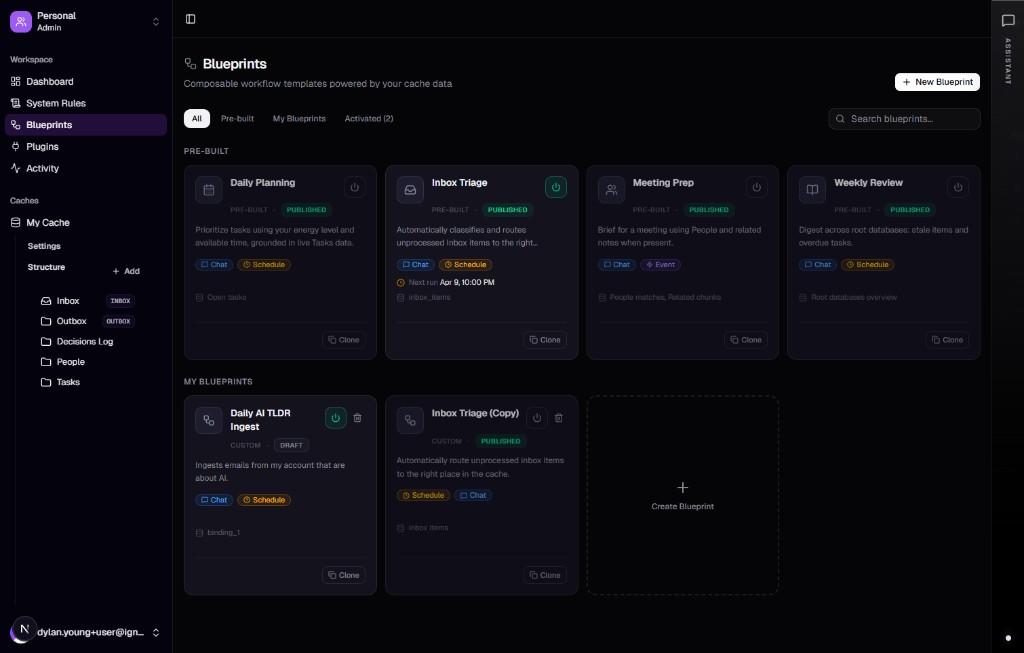
Automations
Blueprints, plugins, and connections—repeatable workflows on top of your knowledge.
Read moreMemory that thinks and acts
Your AI keeps what it learns, finds what it needs, and runs workflows on your behalf—all without writing code.
Second brain
A structured, searchable knowledge store your AI actually uses between sessions.
Intelligent retrieval
Vector search scoped to what matters—no prompt stuffing, no data leaks.
No-code blueprints
Wire up agents, triggers, and data sources visually. Ship automations in minutes.
Agents that learn
Every interaction feeds back into memory—your AI gets smarter the more you use it.
Your data, your rules
Everything lives in your database—not a black-box SaaS you can't export from. You decide what your AI knows, who can access it, and how long it stays.
- Scoped caches you own—export, migrate, or delete anytime
- Agents and blueprints that get smarter as your data grows
- One dashboard for memory, chat, and automation
Illustrative — your data never leaves your database.
Works inside the tools you already use
Connect through MCP or API so every assistant—Claude Desktop, Cursor, ChatGPT, or your own—shares the same brain and can trigger the same automations.
- Claude DesktopClaude Desktop
- Claude CodeClaude Code
- Visual Studio CodeVisual Studio Code
- CursorCursor
- ChatGPTChatGPT


Connect tools via Model Context Protocol. When enabled, Claude can call your ContextCache server during this conversation.
ContextCache
https://mcp.contextcache…/sse
Tools
- search · retrieve · list_caches
Plug into everything
Connect the services you rely on so your AI can pull context, push updates, and act across tools. Everything listed here is available in the product today.
- ContextCacheLive
The built-in ContextCache MCP server. Two single-call tools for external LLMs: save data into the user's Inbox, and retrieve relevant knowledge via semantic search.
- GmailLive
Read and sync emails from Gmail accounts.
- Google CalendarLive
Sync events from Google Calendar.
- RSS FeedLive
Content — Fetch RSS or Atom feeds and return recent entries, or load full article text from an item link. No authentication required.
- URL FetchLive
Content — Fetch any URL and extract the main content as clean text. No authentication required.
- Web SearchLive
Search the web via Tavily and ingest results.
Mobile apps
Your second brain in your pocket—capture ideas, check on agents, and search your knowledge from anywhere.
iOS and Android coming soon
Simple pricing
Free
- 1 cache
- 250 chunks
- 10 blueprint runs/mo
- Inbox processor: weekly
- All MCP tools
- Semantic search
Pro
- 1 cache
- 5,000 chunks
- 50 blueprint runs/mo
- Inbox processor: daily
- All AI jobs
- Gravity model
- Web ingest (3 sources)
Business
+$9.99/user/mo after 3 users
- Up to 3 caches
- 5,000 chunks/cache
- 150 blueprint runs/user/mo
- Shared caches
- Synthesis engine
- Web ingest (5 sources)
Enterprise
- Unlimited caches
- Custom chunks
- Unlimited blueprint runs
- Inbox: real-time
- Dedicated instance
- Audit logs + SLA
What counts as a blueprint run?
Every time an agent or blueprint runs an AI-powered step, that counts as one run — whether it's processing your inbox, linking related knowledge, summarizing a document, or syncing data from an integration. Storage, MCP tools, and semantic search are always free.
Limits may increase as we optimize. Early adopters will always be rewarded.
Ready to give your AI a chief of staff?
Start free—build your first cache, connect an agent, and see what memory plus automation can unlock.